Saddle On, Tape Billet to Billet
How to Measure a Girth
Measure on the saddle you ride in, match the length to your billets, then check the maker's own chart before you buy.
Put your saddle and pad on, then run a tape from the middle billet hole on one side to the same hole on the other. That number is your girth size. If you land between sizes, go up, never down.
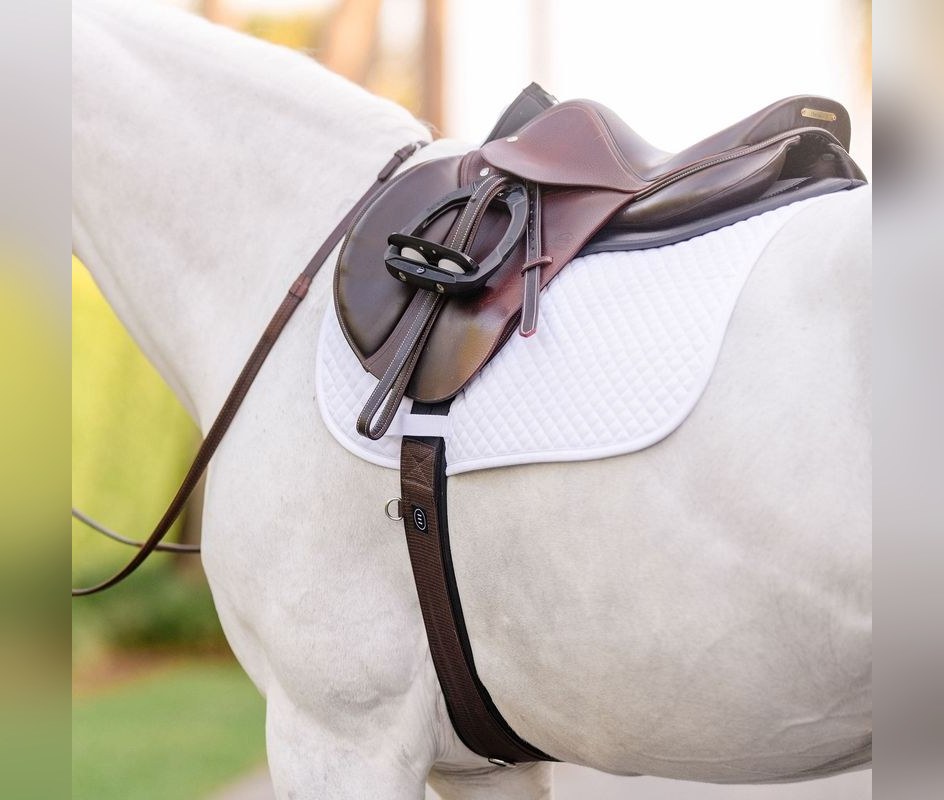
How to measure a girth for your saddle, billet to billet
Measure a girth billet to billet on the saddle you will actually ride in: saddle and pad on, tape from the middle billet hole on one side to the same hole on the other. That measurement is the girth size, and it changes whenever the saddle does. For a longer walk-through, see what size girth your horse needs.
- Put the saddle and the pad you ride in on your horse, so the measurement reflects your real setup.
- Run a soft tape from the middle billet hole on one side, under the belly about a hand behind the elbow, to the same billet hole on the other side.
- Read the number. That is your girth size, in inches or centimeters depending on the maker.
- Check the buckle-to-buckle length of the girth you want, because makers measure differently. Buy that size, or one up if you land between sizes.
- Once it is on, leave two to three fingers between the top of the girth and the bottom of the pad. Measure again any time you change saddles.
Long girth or short dressage girth: which your saddle takes
Your saddle's billets decide whether you need a long girth or a short one. Jumping and all-purpose saddles with high billets usually take a long girth, often 105 to 140 cm. Dressage saddles, and monoflap eventing saddles whose billets extend below the flap, usually take a short girth, often 50 to 80 cm. There is no reliable formula for turning a long size into a short one, so measure the billet holes on the actual saddle. Western saddles use a cinch and its own size guide instead. More on the choice in long girth or dressage girth.
| Your saddle | Girth family | Typical size range |
|---|---|---|
| Dressage saddle with long billets | Short girth | |
| Monoflap dressage or eventing saddle, billets extending below the flap | Short girth | A short monoflap stud girth line runs 18 to 30 in |
| Pony or small horse in a long-billet saddle | Long girth, shortest sizes | Our shortest long English lines start at 34 and 36 inches |
| Western saddle | Cinch |
Girth size chart by brand: inches, centimeters and EU sizes
Girth sizes are not standard across makers, so measure first and then read the maker's own chart. The charts below print what each maker lists: an EU-to-US length conversion, EquiFit's BellyBand sizes by circumference, a letter-coded chart in inches, and a centimeter-to-inch table. One chart note suggests adding or subtracting about 20 inches to move between short and long girths. Use that only as a rough guide, because the billets on your own saddle decide the size.
| EU Size | US Size |
|---|---|
| 40 cm | 16" |
| 45 cm | 18" |
| 50 cm | 20" |
| 55 cm | 22" |
| 60 cm | 24" |
| 65 cm | 26" |
| 70 cm | 28" |
| 80 cm | 32" |
| 90 cm | 36" |
| 100 cm | 40" |
| 110 cm | 44" |
| 120 cm | 48" |
| 130 cm | 52" |
| 140 cm | 56" |
| 150 cm | 60" |
- To measure the length of the girth you need, start with placing the saddle pad and saddle on the horse. Using a tape measure, measure the distance from the middle billet hole on one side of the saddle to the same position on the other side. The tape should be placed about one hand's width behind the horse's elbow. This measurement equals the size of the girth. As saddles have different sizes and strap lengths, it may be necessary to measure for a new girth if you change your saddle.
- To switch between short (dressage) and long girths, add or subtract about 20 inches (51 cm) respectively.
| Size | Circumference (in.) | BellyBand Width (in.) | BellyBand+ Width (in.) |
|---|---|---|---|
| Pony | 62" | 12" | 16" |
| Cob | 73" | 12" | 16" |
| Horse | 75" | 12" | 16" |
| Oversize | 77" | 12" | 16" |
- For questions or more information call 877.437.8434 or visit EquiFit.net.
- Measuring the barrel circumference of your horse will ensure the most accurate fit. However, if you are unsure of sizing, one of our Experts will be happy to guide you at 877.437.8434 or info@equifit.net.
| A | B | C | D |
|---|---|---|---|
| 22’’ | 5.75’’ | 4.5’’ | 5’’ |
| 24’’ | 5.75’’ | 4.5’’ | 5’’ |
| 26’’ | 5.75’’ | 4.5’’ | 5’’ |
| 28’’ | 5.75’’ | 4.5’’ | 5’’ |
| 30’’ | 5.75’’ | 4.5’’ | 5’’ |
| 32’’ | 5.75’’ | 4.5’’ | 5’’ |
| 34’’ | 5.75’’ | 4.5’’ | 5’’ |
- Measure for an Accurate Fit
- If you are unsure of sizing, one of our Experts will be happy to guide you at 877-437-8434 or info@equifit.net.
| CM | INCHES |
|---|---|
| 66 | 26 |
| 71 | 28 |
| 76 | 30 |
| 81 | 32 |
| 86 | 34 |
Between girth sizes, growth and weight change: which way to go
Between sizes, round up rather than down. Never size down on the assumption that elastic will stretch to fit. A girth that is a little long still lets you buckle onto the middle holes, which leaves give in both directions. A girth at the very limit of its holes leaves none. A growing horse or one whose weight changes can use a little extra length for the same reason. Riders tell us sizing is not exact: one found a girth ran about an inch small, and another had a 48 inch girth that sat one hole higher than she wanted. Check the maker's size chart, then see what size girth your horse needs.
LeMieux Fleece Lined Anatomic Girth
My sensitive skinmed horse no longer has girth galls thanks to this girth. The girth does run about an inch small, so it was initially hard to get it on. The 56” was the largest available size, so I am glad it will go on.
Currently I use a super soft/fluffy Arma 48” girth that goes one hole higher than I would like.
Girth fit by build: pony, round barrel, forward groove, big horse
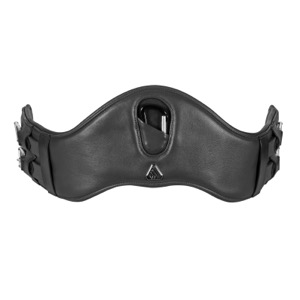
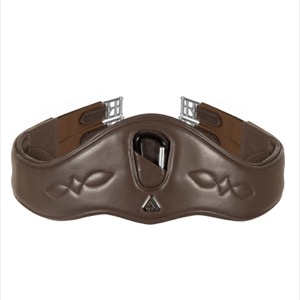
Build changes where you start in a size range, not how you measure. A pony or small horse in a long-billet saddle may need a line that starts low: Ovation Airform Chafeless starts at 34 in, while Henri de Rivel Memor-X and EquiFit Essential Schooling start at 36 in. In a dressage saddle, the short lines list down to 18 in. A round barrel or a forward girth groove points to an anatomic or contoured shape, such as Shires ARMA Anatomic or Collegiate Anatomic. For a big warmblood, Shires Salisbury Atherstone runs to 58 in, and Ovation Airform Chafeless, Shires Memory Foam and EquiFit Essential Schooling run to 60 in. Look elsewhere if your measurement is above the longest size in the line you like.
| Horse or situation | What goes wrong | What to look for | Where to start in our lines |
|---|---|---|---|
| Pony or small horse in a long-billet saddle | One rider found long English girths hard to find in shorter lengths | A line that starts low. Check the shortest listed size before anything else | Ovation Airform Chafeless starts at 34 in. Henri de Rivel Memor-X and EquiFit Essential Schooling start at 36 in |
| Pony or small horse in a dressage saddle | A short line that goes down to 18 in | Ovation Airform Humane, Shires Velociti Lusso, ARMA Anti-Chafe Dressage and Collegiate Memory Foam Dressage all list 18 in | |
| Round pony or round barrel with little wither | The saddle slides forward and the girth rides close to the shoulder | Shires ARMA Anatomic, Collegiate Anatomic, Henri de Rivel Contoured Leather Sherpa Fleece | |
| Forward girth groove | The girth lies near the shoulder and pulls the saddle forward | The anatomic and contoured lines above | |
| Big warmblood or large barrel | A line that runs to 58 or 60 in | Shires Salisbury Atherstone to 58 in, Ovation Airform Chafeless, Shires Memory Foam and EquiFit Essential Schooling to 60 in | |
| Stocky belly, or a horse whose weight changes | Centaur's girth guide says a girth at the limit of its holes leaves no give | Centaur's girth guide says a little extra length, with the billets landing on the middle holes |
Girth sizes by length class, from 18 to 60 inches
Girth sizes run from 18 inches in the shortest dressage lines to 60 inches in the longest English lines. Long English lines start in the mid 30s, short dressage lines mostly list 18 to 30 in, and a few lines list centimeters instead. Find your length class first, then the line, and look at the elastic column if you want ends with give.
| Line | Length class | Sizes carried | Elastic ends |
|---|---|---|---|
| Ovation Airform Chafeless | 34 to 60 in | Double elastic | |
| Shires ARMA Performance Atherstone with Elastic | Long | 38 to 54 in | Double elastic |
| Henri de Rivel Synthetic Fleece | Long | 36 to 56 in | Double elastic |
| Rambo Micklem Long Comfort | Long | 110 to 140 cm | Double elastic |
| Ovation Airform Humane Dressage | Short, dressage | 18 to 28 in | Double elastic |
| Ovation Airform Monoflap | 18 to 30 in | Double elastic | |
| Shires ARMA Anti-Chafe Dressage with Elastic | Short, dressage | 18 to 30 in | Double elastic |
| Shires Velociti Lusso Dressage | Short, dressage | 18 to 30 in | Double elastic |
| Nunn Finer Piaffe | Short, dressage | 20 to 30 in | |
| Collegiate Memory Foam Dressage | Short, dressage | 18 to 36 in | Double elastic |
| Back on Track Dressage Welltex Elastic | Short, dressage | 45 to 75 cm | Double elastic |
| Horze Dressage Neoprene | Short, dressage | 40 to 70 cm |
What riders say about girth fit and sizing
Ovation Gel Body Form Dressage Girth
Perfect for a senior horse with tender skin at shoulder girth line. No more raw skin! For my Friesian cross sporthorse with a round barrel, I tried many saddle/girth combos and this girth is perfect for my Friesian MarketPlace dressage saddle!
Shires ARMA Supafleece Anatomic Girth
It’s a cheaper option but my horse loves his Arma girth like this one. I tried the Fairfax girth but he prefers this girth by far.
I ride in an Australian saddle that requires standard English rigging (no overgirth, but a surcingle strap), and my gelding is a narrow A-frame with practically no girth groove. It's REALLY hard to find long English girths in the shorter lengths for small horses like mine, and I got the shortest 36" size offered back in 2021. This girth is still going strong after years of trail riding, plus it's super easy to clean. I love how secure it is without feeling overly tight. You will DEFINITELY not regret purchasing this girth!
I truly love this girth. It fits my horse amazingly, looks great, and doesn’t irritate his sensitive skin. I have two and absolutely love them!
Shop girths for every saddle and horse
Shop Girths
Shop all ›Dressage, jumping and all-purpose girths, sorted by what your saddle takes. Measure first, then filter the shelf to your size. Check the buckle-to-buckle length on each girth before you choose.
How to Measure a Girth FAQ
How do I measure my horse for a girth?
Put your saddle and pad on, then measure from the middle billet hole on one side, under the belly about a hand behind the elbow, to the same hole on the other side. That length is your girth size. Check the maker's buckle-to-buckle length and size chart, then shop your size.
CloseWhat is the girth size chart for a long or short girth?
Makers print their own charts, and they differ. Short dressage girths are commonly listed from 18 to 36 inches in even steps, and long English girths from the mid 30s into the 60s. Measure first, then read the chart for the exact girth you want. Use the charts above to compare.
CloseLong girth or short dressage girth: which do I need?
Your saddle's billets decide it. High billets on a jumping or all-purpose saddle take a long girth, while dressage saddles and monoflap eventing saddles take a short one. No reliable formula converts one to the other, so measure the same billet holes on your saddle before you shop.
CloseWhat if my horse is between girth sizes?
Go up, never down. Do not assume elastic will stretch to cover a girth that is too short. A little extra length lets you buckle on the middle holes with give in both directions. Check the maker's size chart, then pick the longer size.
CloseHow tight should a girth be?
Firm, not overly tight. With the girth done up, leave two to three fingers between the top of the girth and the bottom of the pad, and a hand should slide between girth and skin. Too long interferes with the pad, and too short can press on the elbow. Recheck your fit before every ride.
Close