The Foundation
What Your Saddle Pad Is Actually Doing
A saddle pad does a lot more than keep the underside of your saddle clean. The right pad distributes pressure evenly across your horse's back, manages sweat and heat during work, and keeps the saddle sitting exactly where it should — whether you're schooling, competing, or heading out on the trail. Knowing what each job requires helps you pick the pad that's genuinely right for your horse and how you ride.
01
Pressure Distribution
A well-fitted pad spreads the rider's weight more evenly across the horse's back, reducing pressure points — especially important for horses with prominent withers or asymmetrical musculature.
02
Moisture Management
Horses sweat heavily under saddle. Good pads wick moisture away from the back, keeping skin dry and reducing the risk of fungal irritation and hot spots.
03
Saddle Stability
Non-slip materials and correct pad sizing prevent the saddle from shifting mid-ride — critical for jumping, working cattle, or any discipline where sudden direction changes happen.
04
Saddle Protection
A clean, quality pad keeps sweat and hair from soaking into your saddle's leather or synthetic panels, extending its life and maintaining its fit over time.
NOTE
On Pad Thickness
More padding isn't always better — and thicker doesn't always mean more comfortable. A very thick pad can raise the saddle and change its fit. If you're finding that no pad quite works, it's worth having the saddle fit checked separately before adding more bulk underneath it.
By Discipline
Matching Pad to Purpose
The discipline you ride shapes everything: the saddle shape, how long you're in the tack, the contact between horse and rider, and how much shock absorption or stability the pad needs to provide. Use this as your starting point.
H/J
Hunter / Jumper
English
Hunter/jumper pads are cut to follow the forward-flap profile of a jumping saddle. They tend to be low-profile — just enough to protect the horse's back and keep the saddle clean — because the rider's leg position means any excess bulk interferes with feel. White, cream, or hunter-green is traditional for the show ring, though schooling in any colour is perfectly fine. Look for a contoured spine channel and girth loops that keep the pad in place over fences.
Square or shaped cut
Low-profile thickness
Girth loops
Non-slip lining
Shop Close Contact Pads
DR
Dressage
English
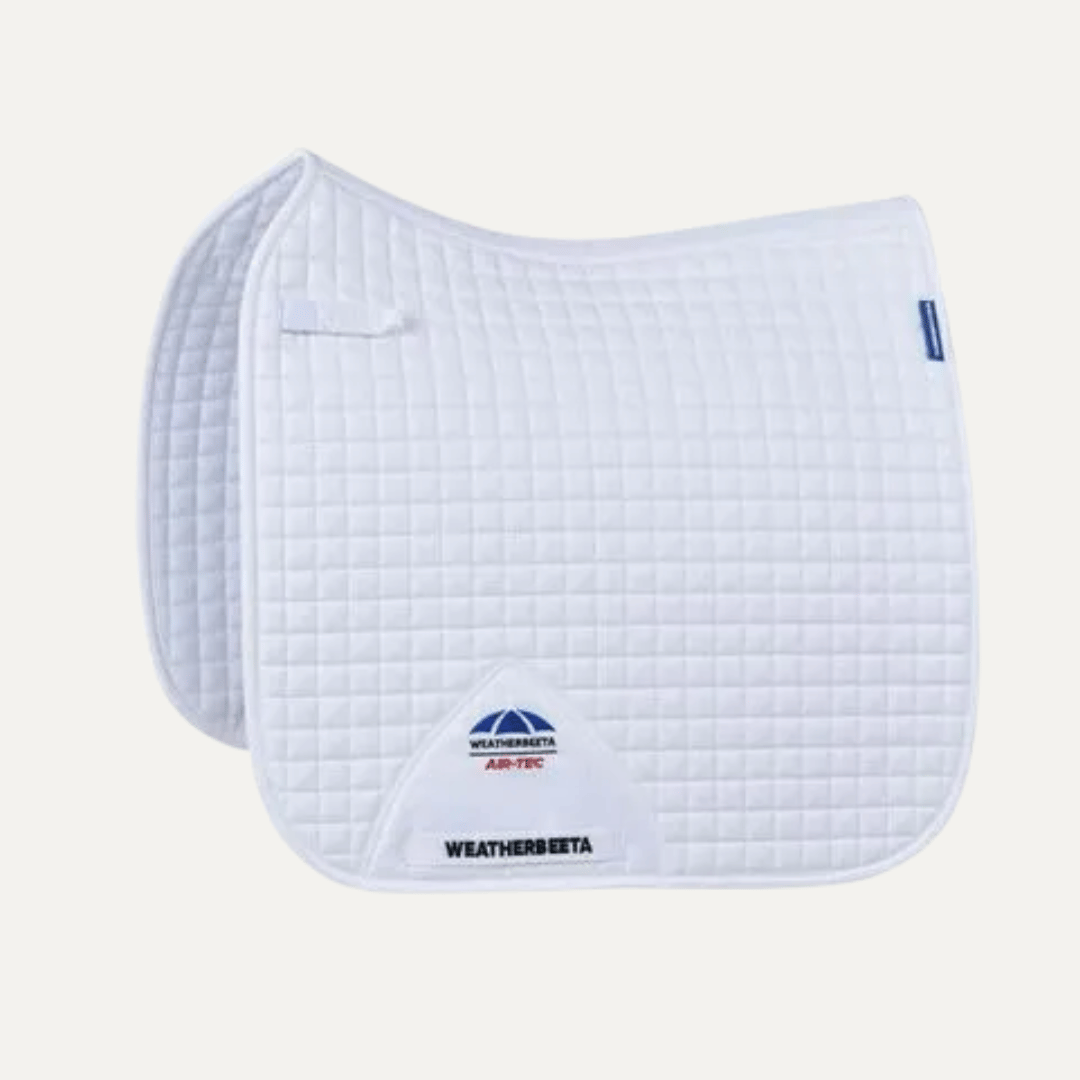
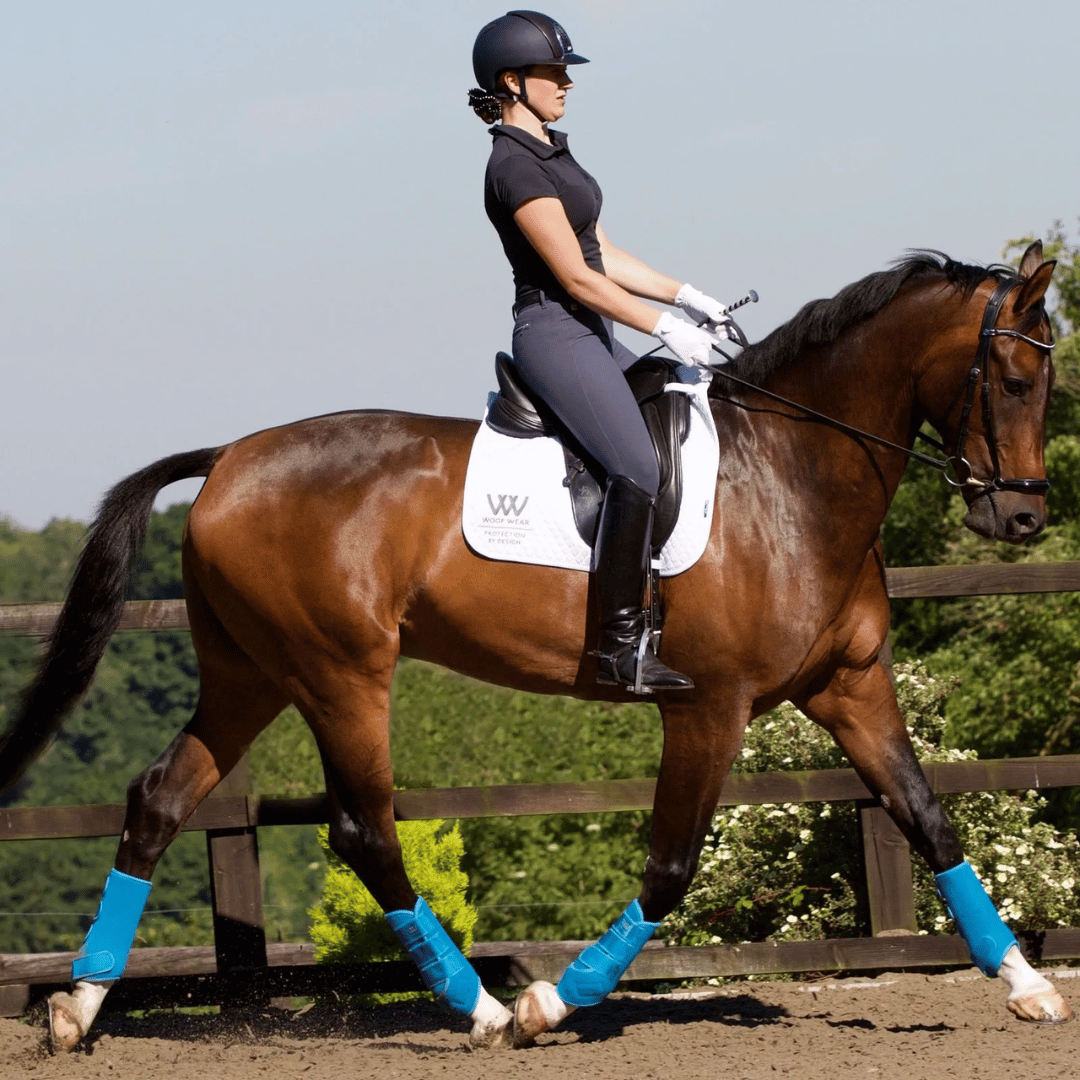
Dressage pads are shaped to the long, straight flap of a dressage saddle — they extend further down the horse's side and have a deep spine channel to protect the vertebrae during collected, elevated work. White is required in competition; schooling pads come in a wide range of colours. The material matters more than in many other disciplines because dressage horses work deeply through the back and any pressure point shows up quickly as tension or resistance.
Long dressage cut
Deep spine channel
White for competition
Quilted cotton or felt
Shop Dressage Pads
WN
Western
Western
Western saddle pads — often called blankets — are built for longer hours in the saddle and a wider tree. They're typically thicker than English pads and are made from wool, wool felt, or cotton, with many featuring traditional woven Navajo or Southwest patterns. Wool is the gold standard: it naturally wicks moisture, is self-cleaning to a degree, and conforms to the horse's back over time. Look for at least ¾" of compressed thickness and a generous size (32"×32" or larger for most horses) to ensure the pad doesn't slide out from under the skirts. Note that wool and felt pads are not machine washable — brush them out after each ride and spot clean as needed.
Thick wool or felt
32"×32" or larger
Woven or solid
Self-conforming
Shop Western Pads
TR
Trail & All-Purpose
English / Western
Trail riders need durability and comfort over long hours — not ring-ready perfection. All-purpose pads work with most general-purpose or trail saddles and are often made with extra-thick foam or gel inserts to cushion long rides on varied terrain. Look for moisture-wicking materials and a secure fit that won't shift when the horse scrambles up a bank or picks through rocks. Many trail riders use a thicker pad than they would in the arena precisely because of the hours and varied movement involved.
Extra cushioning
Moisture-wicking
Non-slip lining
Durable construction
Shop All Purpose Pads
BR
Barrel Racing
Western
Barrel pads need to stay put at speed and through tight turns — that means excellent grip both under the saddle and against the horse's back. Most barrel pads feature a non-slip bottom layer, a cinch slot positioned to allow a forward hang for the saddle's placement, and enough cushion to absorb the concussion of sprinting on hard ground. Avoid any pad that slides or shifts under pressure; a barrel horse that's distracted by discomfort is a horse that drops time. Many barrel riders also prefer a shaped or cut-out back end to keep bulk out from under the cantle during the run.
Non-slip both sides
Forward cinch slot
Shock-absorbing foam
Secured at speed
Shop Western Pads
EN
Endurance & Distance Riding
English / Western
At 25, 50, or 100 miles, even small pressure points become serious problems. Endurance pads are engineered for maximum breathability and long-distance pressure distribution, often using open-cell foam, wool felt, or specialist impact foam. Many riders use a thinner pad than they expect — bulk traps heat; what you want is even weight distribution and fast moisture release. Wicking and quick-drying fabrics are essential; fleece and thick quilted cotton retain heat and moisture at distance, which isn't what you want over eight hours of riding.
High breathability
Open-cell or wool
Quick-drying
Even pressure
Shop High Impact Pads
What Your Budget Gets You
Price Points Explained — No Surprises
Saddle pads span an enormous price range, and it can be genuinely confusing to know what you're actually buying at each level. Here's an honest breakdown: what changes as you spend more, and where the real value sits for different riders.
| Price Tier |
What You Get |
Best For |
Watch Out For |
|
Budget
Under $40
|
Basic quilted cotton or synthetic fill. Decent sweat absorption on easy work. Often standard shaped — straight, square, or contoured. |
Beginners, young riders, light schooling, second-horse backup pads, ponies. |
Thins and flattens quickly. Colour fades fast. May not hold its shape through regular washing. Not for horses with back issues or heavy work schedules. |
|
Mid-Range
$40 – $100
|
Improved materials — better cotton weight, moisture-wicking linings, reinforced stitching, more refined cut. Often includes non-slip panels and girth/cinch loops. More colour and style options. |
Regular riders, most disciplines at schooling level, horses with average backs and standard saddle fits. |
Can still compress over time in high-contact zones. Not the right tool for horses with significant back sensitivity or corrective needs. |
|
Premium
$100 – $200
|
Technical materials: memory foam, impact gel, high-density wool felt, bamboo-blend wicking liners. Anatomical contouring. Consistent pressure distribution even through heavy work. Holds shape through repeated washing and season-long use. |
Competitive riders, horses with back sensitivity, harder-working horses, riders who want a pad that genuinely lasts two or more seasons. |
Overkill for light hacking or casual use. Some foam types trap heat — check for breathability ratings on trail or endurance use. |
|
Professional
$200+
|
Custom-engineered impact management, biofoam or viscoelastic cores, precision anatomy mapping, corrective shim systems. Some offer custom sizing and back-profiling. Used by FEI-level competitors and horses under intensive training schedules. |
High-performance horses, horses recovering from back soreness, elite competition, or where a saddler has identified specific pressure distribution needs. |
Not necessary for most pleasure or amateur competition riders. The upgrade from premium to professional often returns less per dollar than going from budget to mid-range. |
💡
The Best Value in the Range
For most dedicated amateur riders on healthy horses, the $60–$120 sweet spot delivers the biggest jump in quality per dollar. You get proper moisture management, a pad that holds its shape, and a fit that actually works with your saddle — without paying for engineering you don't need.
Getting the Fit Right
Five Things to Check Every Time You Tack Up
-
1
Match the Cut to the Saddle
A dressage pad under a jumping saddle — or vice versa — will leave sections of the saddle unsupported and other sections flapping. Always match the pad's cut to your saddle style: square/AP for all-purpose, forward-cut for jumping, straight cut for dressage.
-
2
Check the Spine Channel
There should be clear, uninterrupted space along the horse's spine from front to back once the saddle and pad are in place. If the material compresses over the spine, even a small amount, switch to a pad with a deeper channel or raised spine seam.
-
3
The Pad Should Show Evenly Around the Saddle
Roughly 1–2 inches of pad should be visible all the way around the saddle — front, back, and sides. Too little means the saddle edge is riding on the horse; too much means excess material bunching under the panels.
-
4
Pull It Up Into the Gullet
Before you mount, pull the front of the pad up into the saddle's gullet (the channel over the withers). This prevents the pad from pressing down on the withers as the saddle settles during work — one of the most common sources of wither soreness.
-
5
Check for Movement After 10 Minutes
After your first 10 minutes of work, check where the pad has moved. If it's slipped back, you may need girth loops, a different cut, or a non-slip liner. A pad that migrates consistently during work is a problem that doesn't go away on its own.
The Core Rule
The best saddle pad is the one that disappears — for horse and rider alike.
If your horse is moving freely, sweating evenly, and not showing sore spots after work, and your saddle sits level and still — the pad is doing its job. You shouldn't have to think about it mid-ride.
Find the Right Pad for Your Horse
Browse TOD's full selection of English and Western saddle pads — from everyday schooling pads to professional-grade performance options. Hundreds of styles, sizes, and price points, always at deal prices.