What weight blanket do I need at what temperature?
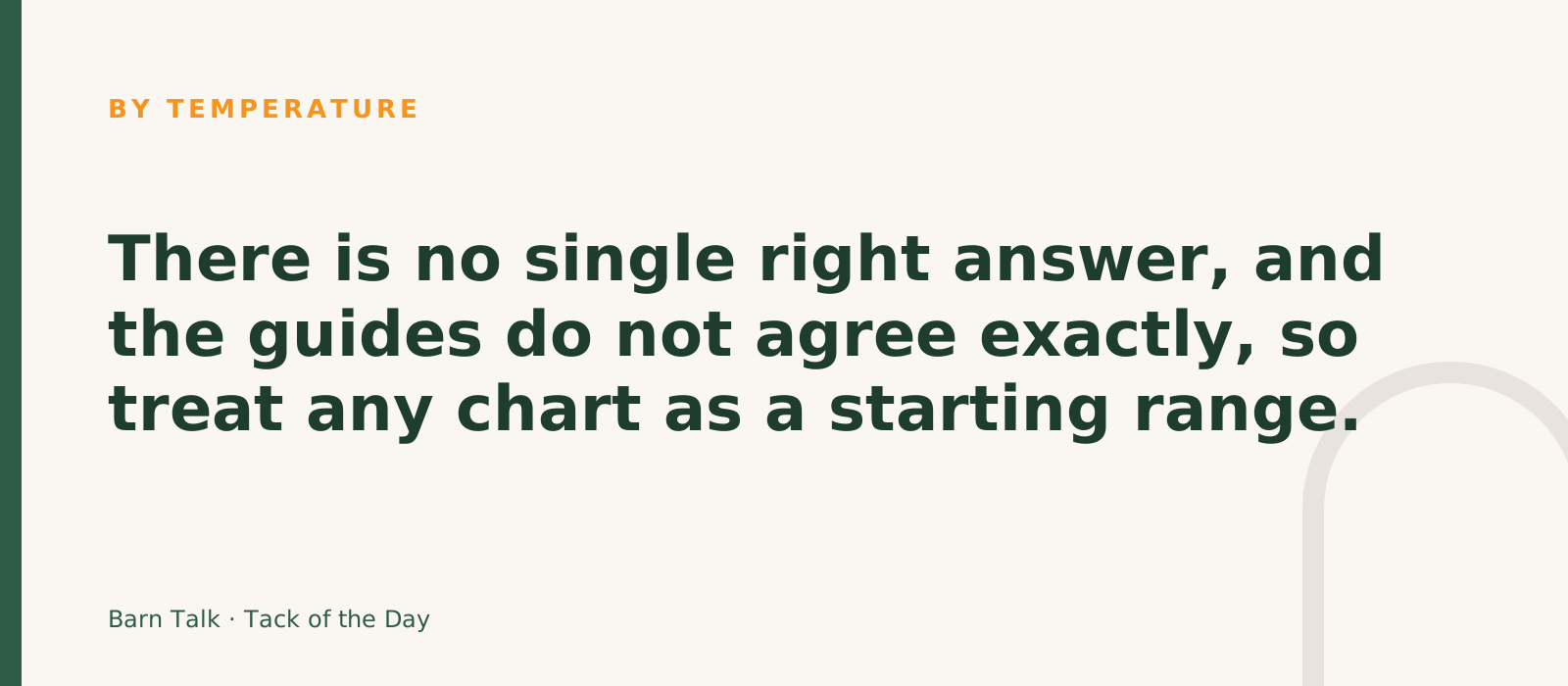
There is no single right answer, and the guides do not agree exactly, so treat any chart as a starting range. The table shows how the guides we read line up for a turnout blanket: our own tools, a university extension bulletin, two more extension programs and a UK magazine. Temperatures are Fahrenheit. Horse & Hound's Celsius bands are converted.
The gap between guides is usually one weight. At 35°F, an unclipped horse is in 'no blanket, or a rain sheet if it is raining' in the University of Maine bulletin, 'no rug, or 150 to 200 g' in Horse & Hound, and 'medium, 200 to 299 g' in our calculator. Some of that is climate and audience, since the Maine bulletin is written for Maine winters and Horse & Hound for UK horses. Some is just judgment.
Manufacturers mostly do not publish temperature ranges. Horseware's blanket guide says horses may need blankets when temperatures fall below 40°F, depending on clipping and cold tolerance, and puts a horse's thermoneutral zone at 41°F to 77°F (5°C to 25°C). WeatherBeeta's warmth-options page lists fill weights with no temperatures. We found no temperature chart on a Shires page.
| Guide | Unclipped horse | Clipped horse |
|---|---|---|
| Our Blanket Weight Calculator (2026) | Above 50°F: none. 40-50°F: sheet or lightweight (0-199 g). 30-40°F: medium (200-299 g). Below 30°F: heavy (300-399 g). | Above 50°F: sheet or lightweight. 40-50°F: medium. 30-40°F: heavy. Below 30°F: extra heavy (400 g+) or layer. |
| Our older Horse Blanket Guide (not split by clip) | 60°F+: none for most. 50-60°F: most need nothing in dry weather. 35-50°F: lightweight (50-100 g); healthy unclipped may be fine bare. 20-35°F: medium (150-200 g). Below 20°F: heavyweight (300 g+). | 50-60°F: sheet or lightweight. 20-35°F: medium plus a liner for clipped horses or poor doers. Below 20°F: heavyweight, with a liner if particularly clipped or condition-sensitive. |
| University of Maine Extension Bulletin 1038 (2025) | 40°F and above: none. 25-39°F: none, or a rain sheet if raining. 15-24°F: light or midweight. 0-14°F: heavyweight. Below 0°F: heavyweight, liner and hood. | 40-50°F: rain sheet or lightweight. 25-39°F: light or midweight. 15-24°F: heavyweight. Below 15°F: heavyweight, liner and hood. |
| Penn State Extension (2026) and University of Georgia Extension (2026) | Penn State: blanket if there is no shelter and the temperature or wind chill is below 5°F; a woolly horse with a thick coat is sometimes better left unblanketed. Georgia: lower critical temperatures of about 5°F, 18°F or 40°F depending on coat and what the horse is used to. | Neither gives a separate clipped-horse chart. Penn State lists a very young or very old horse, one that has not acclimated and a body condition score of 3 or less as reasons to blanket sooner. |
| Horse & Hound (UK, Nov 2025), turnout, converted from °C | 50-59°F: none. 41-50°F: none, rain sheet or 50-100 g. 32-39°F: none, or 150-200 g. 14-32°F: 150-300 g with neck cover. Below 14°F: 300-500 g with neck cover. | 50-59°F: none, or rain sheet or 50-100 g if wet and windy. 41-50°F: 100-150 g. 32-39°F: 200 g. 14-32°F: 300-400 g, plus neck cover and liner if needed. Below 14°F: 300-500 g plus liner. |
Read the forecast for wind and rain, not just the number. The extension sources all say wet and wind change how cold a horse feels, so a chart's 35°F is a starting point, not a promise.
What do 'light,' 'medium' and 'heavy' actually mean in grams?
Go by the grams, not the name. Fill is measured in grams, and it tells you how warm a blanket is, not how heavy. Brands draw the lines differently, and our Blanket Weight Calculator notes that some blankets sold as 'medium' have 150 g of fill.
Horseware's Vari-Layer works a little differently. It stacks the fill, with the heaviest layer over the top and lighter layers down the sides, so the gram number on those blankets is the fill over the back, where it is thickest.
| Guide | Lightweight | Medium | Heavy |
|---|---|---|---|
| Horseware | 0-100 g | 150-250 g | 300 g and up |
| WeatherBeeta | No fill (light); 50 g (light plus); 100 g (medium/light) | About 220 g | 300+ g |
| Our Blanket Weight Calculator | Sheet or lightweight, 0-199 g | 200-299 g | 300-399 g; extra heavy 400 g+ |
| Our older Horse Blanket Guide | 50-100 g (0 g is a sheet) | 150-200 g | 250-400 g+ |
| Horse & Hound (UK, turnout) | 50-100 g (a rain sheet is none) | 150-200 g | 300-500 g, with neck cover |

One of the questions riders search is how many grams a 'medium' blanket is. The honest answer is that it depends who made it. Read the grams on the tag, not the word on the front.
Does clipping change the weight he needs?
Yes. A clipped horse usually needs more blanket for the same temperature. Horseware puts it this way: the more hair removed, the more fill the blanket needs to make up for it, and once temperatures drop or a horse is clipped, a heavyweight may suit better than a medium. The University of Maine bulletin says clipped horses need several blankets at about 40°F and below, indoors and out.
Our Blanket Weight Calculator goes up one weight, and only one, if the horse is clipped, older or underweight, or thin-skinned, however many of those apply. A cold snap that is colder than your horse is used to calls for a liner rather than a heavier shell. Horse & Hound counts a low trace clip as unclipped, especially for good-doers or overweight horses.
Other things move the answer too. Penn State Extension lists a very young or very old horse, a horse that has not acclimated (for instance, one moved from a southern climate) and a body condition score of 3 or less as reasons to blanket sooner, and says a woolly horse with a thick coat is sometimes better left unblanketed. Maine's bulletin says horses from warmer climates that have not grown a winter coat should be blanketed like clipped horses, and that it can take one or two winters for them to adapt. The University of Georgia adds that shelter from wind and rain changes how cold a horse feels.
If the weather is wet as well as cold, see can I blanket a wet horse? And once you know the weight, which cut fits his build helps you choose the shape.
If you clip, decide on the blanket wardrobe before the clippers come out. A clipped horse usually needs more fill at the same temperature, and it's easier to have the right weight and a liner ready than to scramble on the first cold night.
Should I layer a liner or buy a heavyweight?
Both work. The choice is mostly about how many pieces you want to manage. Horseware says that instead of layering several blankets, you can attach liners to liner loops in the blanket, and that liners are easy to clean and work in both stable and turnout blankets. our Horseware blanket guide describes a liner-compatible turnout plus a liner as a light, medium or heavy blanket from one shell. Horseware liners come in 50, 100, 200 and 400 g, and the liner attaches at the neck and clips at the back so it does not slip.
The University of Maine bulletin lists a stable sheet or liner as 0 g and quilted liners as 100 to 300 g, notes that liners and stable sheets are generally not made to get wet, and includes a liner in the setup for full-coated horses below 0°F and clipped horses below 15°F. A liner earns its keep in a cold snap, since you can take it out when the weather eases.
The other side is simplicity. One heavyweight can be easier when other people handle the blankets, as this rider found.
“I considered a nice liner for a medium, but I have limited blanket storage at the barn and have to rely on other people to make the changes. Easier to give them a temperature to switch to the heavy than orchestrate when a liner goes on/off and it's also easier for them to not forget if the liner is on/off if the blankets are just different.”
Rider review · 2012Quoted word for word from public rider discussions and checked against the original posts, November 2026.
How can I tell if he is too hot or too cold under the blanket?
Put a hand under the blanket at the base of the neck and behind the shoulder. Dry and comfortable is right, sweating means go lighter, and shivering means go heavier. That is the check in our Blanket Weight Calculator. Rutgers says the same, and adds to check a short time after blanketing.
Signs he is too cold: the University of Georgia lists skin that feels cold under the coat, a hunched posture, stiff movement and huddling with other horses, and says a horse that is not shivering is likely not cold. The University of Maine lists shivering and a horse that will not leave his shelter.
Signs he is too warm: Georgia lists profuse sweating, hot skin and rapid breathing as heat stress and says sweating under a blanket without exertion suggests it went on at too warm a temperature. Maine's bulletin warns that a blanket put on at 10°F and left on at 40°F may cause sweating, and then shivering at nightfall. Penn State says to take the blanket off on warm days so he doesn't sweat and end up wet underneath.
Horses differ. Take the blanket off at least once a week to groom and look for rubs, skin problems and weight changes (Rutgers). If a horse shows signs of heat stress, or seems unusually cold, lethargic or unwell, call your vet.
“When it got down to -12F, he wore his 100g liner, 200g liner and 100g blanket for a few days. Otherwise, he was warm and toasty all winter in 200-300g of total fill. He runs hot anyway, so I often found myself blanketing him 100g less than I thought I would be at a given temperature.”
Rider review · 2014Quoted word for word from public rider discussions and checked against the original posts, November 2026.
Hand under the blanket at the shoulder every time you pass. Sweat means lighter. Shivering means heavier. Change the blanket, not the chart.
Is there a quick way to get a starting point?
Yes. Use a tool for the first guess, then check the horse. Our Blanket Weight Calculator takes the temperature and a few details about your horse and suggests a weight. The Blanket Selector narrows blankets by horse and weather. The calculator ends with the same advice as the guides above: when in doubt, blanket lighter, because a horse that is too warm sweats under the blanket and a damp coat chills him.
Revisit the choice when the forecast changes, when he is clipped, or when his condition shifts. A weight that was right last month may not be right now.
Barn words on this page
- Fill weight
- The amount of insulation in a blanket, measured in grams. More fill means more warmth, not more weight on the horse.
- Sheet
- A blanket with no fill (0 g). It blocks wind and rain and adds little warmth.
- Liner
- A fill layer that attaches inside a blanket to add warmth without a whole new blanket.
- Thermoneutral zone
- The temperature range in which a horse doesn't need to work to stay warm. Horseware gives it as 41°F to 77°F (5°C to 25°C).
- Clip types
- Clips run from a bib clip, which removes little hair, to a hunter or full clip, which removes most or all of it (Horseware). The more hair removed, the more fill the blanket needs.
- Neck cover
- A detachable or built-in hood section that extends warmth over the neck.
Quick questions
How many grams is a medium horse blanket?
It depends on the brand. Horseware puts medium at 150-250 g, WeatherBeeta's medium is about 220 g, our calculator uses 200-299 g and Horse & Hound uses 150-200 g. Go by the grams on the tag.
Will blanketing early stop him growing a winter coat?
Rutgers says horses naturally grow more hair as days shorten, even while fall weather is still warm, and that constant blanketing can flatten the coat and reduce its insulating ability. Once you start blanketing, expect to continue all season.
Does a horse with a full winter coat need a blanket?
Often not until it gets quite cold. Penn State says woolly horses with a thicker coat can retain more heat, so it is sometimes better not to blanket. Rain, wind, no shelter, age and body condition change that.
What is the warmest blanket?
Warmth comes from fill, plus layers and a neck cover. Our calculator tops out at extra heavy, 400 g and up or a layered setup, and Horseware's Vari-Layer heavy is sold as 450 g over the back.
Is a liner better than a heavyweight?
Guides present both. A liner gives you several weights from one shell and is easy to clean, while a single heavyweight is simpler when other people handle the blankets. Which is better depends on your barn.
Does rain change the weight I need?
It can. Wet and wind lower the temperature at which a horse gets cold, and our guide to keeping your horse dry suggests using the higher end of the usual ranges in rain. See our answer on blanketing a wet horse.