Where do I put the tape to measure for a riding helmet?
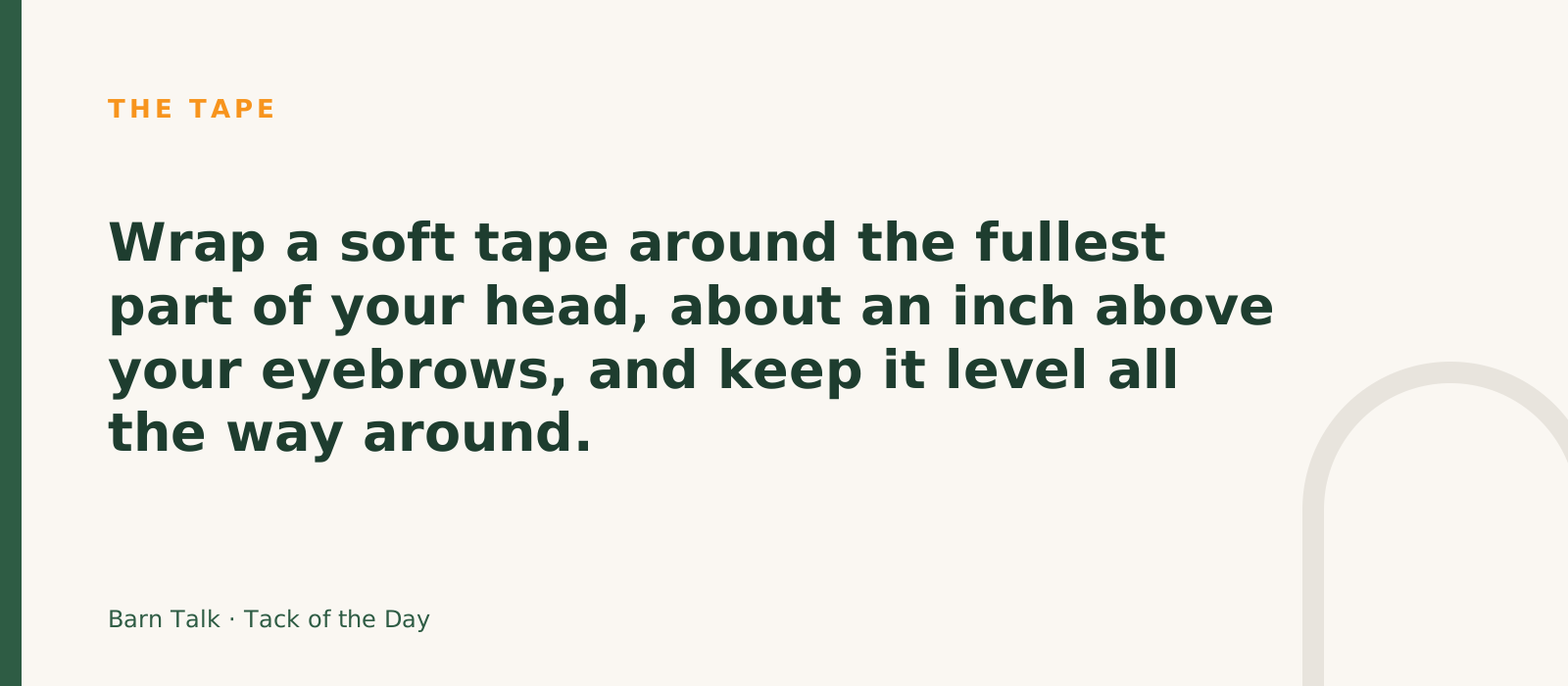
Wrap a soft tape around the fullest part of your head, about an inch above your eyebrows, and keep it level all the way around. Troxel, Alberta's helmet guide and our own guides all point to the same spot. Our Helmet Center puts it as running the tape about an inch above your eyebrows, at the widest point, with your hair the way you ride.
Use a soft fabric tape, the kind a tailor uses, not a rigid one. Our Helmet Buyer's Guide says to take three measurements and use the largest. The CDC's Heads Up fact sheet adds that the tape should stay level, so it doesn't dip at the back. If you don't own a tape, Troxel says a piece of string works: wrap it the same way, lay it flat and measure its length.
Write the number down in centimeters and inches, since brands ask for one or the other.
Have someone hold the tape at the back of your head while you hold the front. It's the back that wanders, and a tape that tilts gives you a number that is off.
Centimeters, inches or hat size: which number do I use?
Use whichever number the brand's own chart asks for, and treat any conversion chart as a starting point. Brands count in centimeters, inches, hat sizes or small to large, and the numbers don't line up neatly.
Here is Troxel's conversion from head size to hat size. Troxel itself calls its chart a guide, not a guarantee of fit.
Letter sizes are where it gets slippery. The size filters on our riding helmets page list Small as 53 to 56 cm, Medium as 57 to 59 cm and Large as 60 to 61 cm. Our Helmet Buyer's Guide puts a medium at 55 to 56 cm. The point: a medium in one brand is not a medium in another, and the guide warns that a 7 1/4 in one helmet may not fit like a 7 1/4 in another. Order from the chart for the model you want.
| Head (cm) | Head (inches) | Hat size |
|---|---|---|
| 52 | 20 3/8" | 6 1/2 |
| 53 | 20 3/4" | 6 5/8 |
| 54 | 21 1/4" | 6 3/4 |
| 55 | 21 5/8" | 6 7/8 |
| 56 | 22" | 7 |
| 57 | 22 3/8" | 7 1/8 |
| 58 | 22 3/4" | 7 1/4 |
| 59 | 23 1/8" | 7 3/8 |
| 60 | 23 5/8" | 7 1/2 |
| 61 | 24" | 7 5/8 |
| 62 | 24 3/8" | 7 3/4 |
Do I have a round or oval head, and which helmet shape should I buy?
You can't reliably tell by looking in the mirror, so let the helmet tell you. Helmet makers build their shells around particular head profiles, so the same size can feel perfect or terrible depending on the shape. Our Helmet Buyer's Guide says that if the front rides too high or too low, you may need a different size or a different brand's head shape, oval or round.
Two fit guides give you symptoms to work from. Our Helmet Center says that if a helmet presses front and back but gaps at the sides, try a long oval. Trauma Void's guide says pressure on the forehead may mean you need a more oval shape, while a helmet that won't sit down evenly and snugly may suit a rounder one. Many One K styles come in both round and long oval, and Trauma Void lists which of its models are round, oval or universal.
The mirror test is a good one to try at home. Hold the helmet with both hands and rock it gently. If your forehead skin moves with it, the fit is good. If the helmet moves and your skin stays put, it's probably too big or too oval for your head.
Troxel puts it plainly: some helmets fit different shaped heads better than others.
| What you feel | What it may mean | What to try |
|---|---|---|
| Presses front and back, gaps at the sides | The helmet is rounder than your head | A long oval shape |
| Pressure on the forehead | The helmet may not be oval enough | A more oval shape |
| Won't sit down or fit evenly | The helmet may be too oval for you | A rounder shape |
| Helmet shifts while your forehead skin stays still | Too big, or too oval | A smaller size or a rounder shape |
“My takeaway is that no one truly knows the shape of their head or of helmets. So please just try things on and find what works.”
Rider review · 2022Quoted word for word from public rider discussions and checked against the original posts, November 2026.
Helmets to try on
A mix of brands and shapes, since the only real test is how one sits on your head.
What size should I buy if I'm between sizes, and what if the helmet is uncomfortable?
The guides disagree, so use your head: whichever size passes the fit checks with your hair the way you ride. Our Helmet Buyer's Guide says that if you're between sizes, go up, and also says to switch brands before you size up or down. Alberta's helmet guide says visible gaps mean you need a smaller size, and pain or pressure suggests a larger size or a different style. Trauma Void's guide has no between-sizes rule and says riders who wear their hair inside the helmet may need to go up.
Adjustable helmets make this easier. Dial-fit helmets and removable liners in different thicknesses let you fine-tune. University of Idaho 4-H advises opening any dial to its widest setting before you put it on, and starting with the largest liner if you're unsure, then adding pads later.
As for discomfort, there's a difference between snug and sore. Our Helmet Buyer's Guide says a well-fitted helmet should feel snug but not painful after 20 to 30 minutes, and that slight pressure at first is normal. Sharp, persistent pressure points mean the shape isn't right for your head. The CDC notes that a helmet that's too tight can cause headaches. If it hurts, try another shape before you try another size.
“Fits great, is comfortable and a great price. I have a rounder oval shaped head, as opposed to a long oval. I'm on the line between a med and lg, even with non adjustable helmets I'm always in-between two sizes and needed a shim. This helmet was supposed to fit a slightly more round head shape, and it was suggested to size up to Lg if in-between. And it fits perfect, so happy I got the right helmet on the 1st try! I don't need a shim, the adjustment dial doesn't get caught in my hair. It looks good, I get a lot of compliments.”
Rider review · 2026Quoted word for word from public rider discussions and checked against the original posts, November 2026.
If you're stuck between two sizes, try both with your hair done the way you actually ride, then do the shake test in each. Hair changes the answer more than most people expect.
How should a riding helmet fit once it's on?
Snug all the way around, level on your head, and steady when you shake your head. Several sources agree on this checklist. Run it at home with the chin strap fastened.
- Brim: sits about an inch, or two fingers, above your eyebrows and stays level. Not tipped back, not pulled down. (Our Helmet Buyer's Guide, Alberta, CDC)
- All around: snug with no gaps between the padding and your head, and no pressure on your ears. (CDC, Alberta)
- Harness: the side straps form a V just below your ears, and the chin cup sits under your chin, not on your throat. (Our Helmet Buyer's Guide, CDC)
- Chin strap: one or two fingers fit between the strap and your chin. (Troxel, CDC, Trauma Void)
- Shake test: bend over, let your head hang, and shake it up and down and side to side. The helmet shouldn't slide or wobble. (Alberta, University of Idaho 4-H)
- Press and rock: press down on top with the heel of your hand and rock it front to back and side to side. Minimal movement is acceptable. (Our Helmet Buyer's Guide)
- Forward tilt: tilt your head sharply forward and the helmet shouldn't fall over your eyes. (Our Helmet Buyer's Guide)
Check the label too. Look for the ASTM/SEI certification and the date of manufacture. Fit tells you whether it's right for your head, and the label tells you what it was tested to. Our helmet ratings and standards page explains how to read it.
What about long hair, braids and a show bun?
Try the helmet on with your hair exactly the way you'll wear it to ride. That advice shows up everywhere: our Helmet Center, the CDC, University of Idaho 4-H, IRH and Trauma Void all say it. Idaho adds that a ponytail may call for a size up and that, for shows, you should try the helmet with your hair in the competition style, whether that's a bun or tucked up under the helmet.
Our Helmet Buyer's Guide adds a caution in the other direction: don't buy a helmet that only fits with your hair up.
We didn't find a manufacturer fit guide that speaks to braids, locs or natural hair specifically, so the general rule is what we can offer: try it on in the style you wear, run the shake test, and ask the maker if you're unsure. A haircut can change the fit too, as the CDC points out.
“I even have two different size liners for my helmet - one that fits better with my hair out (like if I'm just hacking or something) and one that fits better with my hair up. Miracles of modern helmet technology.”
Rider review · 2016Quoted word for word from public rider discussions and checked against the original posts, November 2026.
How should a child's riding helmet fit, and can they grow into it?
A child's helmet should fit snugly now. Don't buy it big and hope. Troxel's kids' guide is blunt about it: purchase a helmet that fits properly now, not a loose-fitting one. Measure the child's head with a tape one inch above the eyebrows, then check that it fits snug without being uncomfortable, that one or two fingers fit between the strap and chin, and that the helmet sits level with the visor parallel to the ground.
Trauma Void's guide allows a little more room, suggesting you size up for growth only as long as the helmet still adjusts to the child's current head, and warns against compromising on fit or safety. In practice, that means an adjustable helmet that can be tightened to fit today. It doesn't mean a loose one.
Re-measure every season. Our Helmet Buyer's Guide says a helmet that fit in spring may be too tight by fall, and never to hand down a used helmet of unknown history. Troxel says to replace any helmet after a fall, and at least every five years, or sooner if the child rides often. Our Helmet Center lists youth styles from One K and Ovation, and our kids' shop has more.
When should I try on a helmet, and when should I re-check the fit?
Try on several, in person if you can, and re-check whenever something changes. University of Idaho 4-H advises trying on several helmets because head shapes vary, and buying from a dealer trained in helmet fitting. If you're replacing a helmet, it suggests trying the same make and model again, because manufacturers update designs.
Buying online? Measure, choose the model, read that model's size range, and run the fit checks above as soon as it arrives. Troxel says its chart is only a guide.
Re-check the fit after a haircut or a new hairstyle, at the start of each season for a growing rider, and any time a once-snug helmet starts to feel loose. Our Helmet Buyer's Guide says that can mean the internal foam has compressed. Whether it's time to replace one is covered in our Barn Talk on when to replace your riding helmet, and if you're wondering about substitutes, see whether a bike helmet will do.
Barn words on this page
- Dial-fit
- A dial at the back of the helmet that tightens or loosens the fit, so one size covers a small range.
- Liner
- The removable padding inside the helmet. Some brands sell liners in different thicknesses to fine-tune the fit.
- Long oval
- A helmet shape that is longer front to back than it is wide. Round helmets are closer to equal in both directions.
- Harness
- The chin strap and side straps that hold the helmet on. The side straps should form a V just below the ears.
- ASTM/SEI
- A common safety standard and its certification tag for riding helmets in the United States. Check the label inside the helmet.
Quick questions
Do I measure in centimeters or inches?
Follow the chart for the helmet you want. Brands use centimeters, hat sizes or small to large, so record both centimeters and inches and convert as that brand asks.
Can I measure my head with a string?
Yes. Troxel says you can wrap a string around your head the same way you would a tape, lay it flat and measure its length.
Should a new helmet feel tight?
Snug, yes. Painful, no. Our Helmet Buyer's Guide says a well-fitted helmet should feel snug but not painful after 20 to 30 minutes, and that sharp, persistent pressure points mean the shape isn't right.
Can my child wear a bigger helmet to grow into?
Troxel says to buy a helmet that fits properly now, not a loose-fitting one. An adjustable helmet that can be tightened to fit today is the middle ground some brands describe.