
FAST
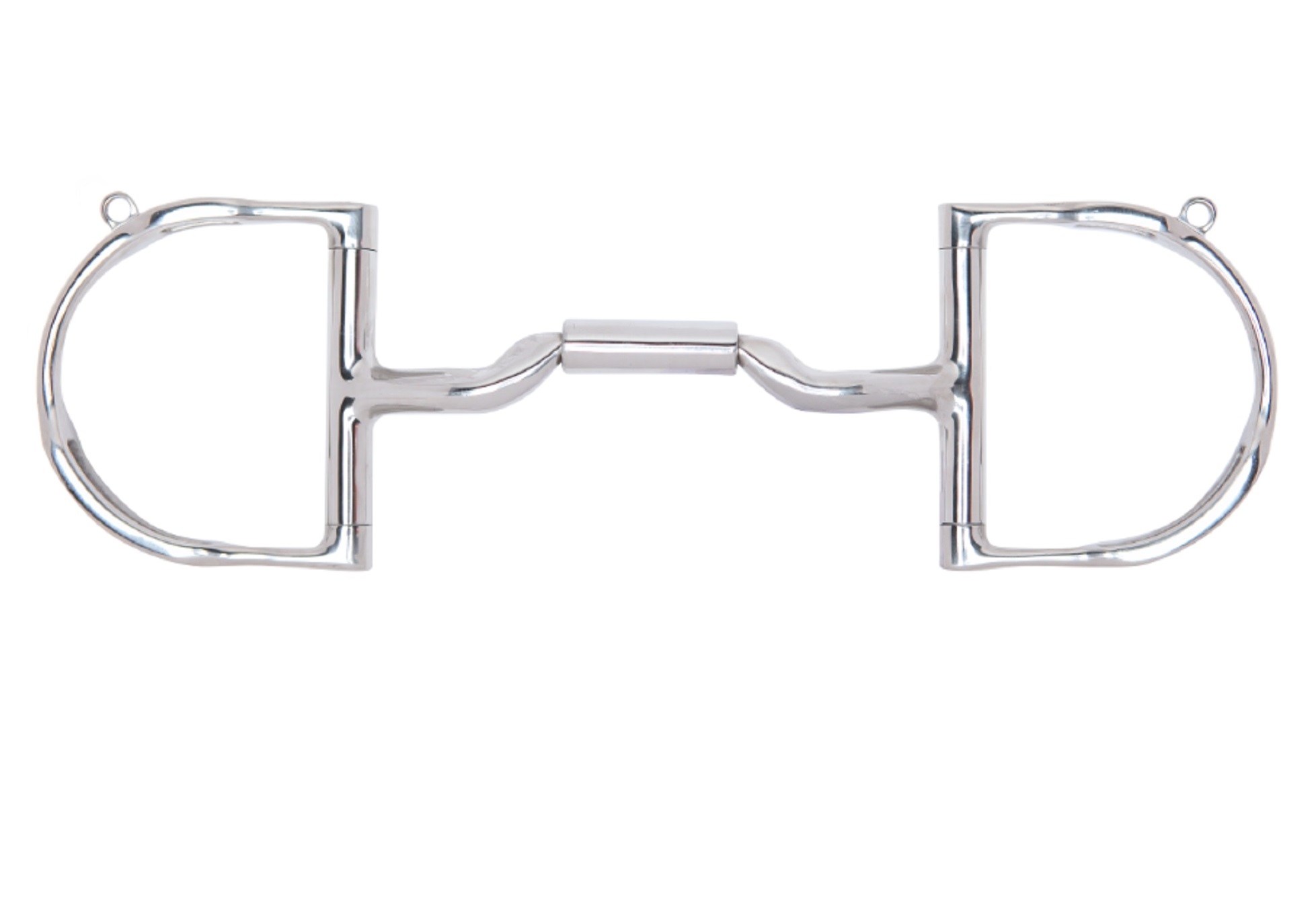
Myler Eggbutt no Hooks Forward Tilt Ported Barrel MB 36
$159.95
Curved Myler mouthpieces graded by level, most with Independent Side Movement
Myler horse bits are graded in levels by a horse's training and temperament, from curved comfort snaffles to wide-ported barrels, with correctional and combination bits and loose ring, eggbutt, D-ring, shank and western cheekpieces for English and Western riders.
Riders tell us a Myler can change a horse's whole attitude toward the bit: a Percheron stopped tossing her head, a gelding stopped inverting and bracing, a Thoroughbred that struggled to accept a bit for years now loves it, and a low-palate Arabian prefers it to any snaffle he has worn.
My Thoroughbred has struggled with accepting the bit for several years, and I've tried multiple bits. He LOVES this bit and is a whole new horse!
My Percheron used to throw her head...a LOT...when I had her in a standard loose ring snaffle. Since the changeover, she no longer tosses her head, and still has brakes and turning. I like the bit because SHE likes the bit.
Myler bits are always quality products, and this bit is no exception. My very picky, large-tongue, low-palate Arabian absolutely prefers this bit over any snaffle he’s ever worn.
I noticed that my gelding's attitude and work ethic improved significantly when we switched to this bit from a traditional snaffle. He has stopped inverting, bracing, and tensing up.
Choose a Myler level by your horse's training and temperament, which is how the maker grades its mouthpieces.
Level 1 mouthpieces, such as the MB 01 and MB 02, rotate onto the tongue to apply tongue pressure, and the maker's level sheet places them with young or green horses just beginning training. Level 2 offers tongue relief through a small port or flexible mouthpiece, for young horses with a steady temperament, older horses starting a new discipline, or retraining after time off; the shelf below shows the Level 2 styles.
Level 2-3 mouthpieces, such as the MB 43 series, give more tongue relief with more bar and poll pressure. Level 3 is the wide-port group for maximum tongue relief, led by the MB 33 and MB 33WL. A horse that resists at one level moves to the next.
Most Myler mouthpieces carry Independent Side Movement through the center barrel, so each side of the bit can act on its own; the exceptions include the MB 12, MB 16, MB 27 and MB 47, which feel more solid. Riders tell us a horse that hates tongue pressure or the nutcracker action of a typical snaffle can settle in a Myler: a hunter mare in a Level 3 ported bit, a 4-year-old OTTB in a roller comfort snaffle.
Myler Level 2 bits
Shop all ›The perfect solution for my hunter mare who hates tongue pressure, and responds well to bar pressure. A beautifully built bit, and a great alternative to riding her in a kimberwick.
My 4 year old OTTB can't stand the nutcracker of a typical snaffle. This bit is great for her, still very basic and light, but the roller keeps her occupied while the curve and joint eliminate the typical snaffle motion. She loves this bit, and so do I!
Myler comfort snaffles are the MB 01, MB 02, MB 03 and MB 04 mouthpieces: curved center-barrel bits that rotate onto the tongue but wrap the bars and lips instead of pinching. The MB 01 replaces a traditional single joint, the MB 02 a French link or lozenge, the MB 03 adds a copper roller, and the MB 04 adds a small 1/4 inch port.
The MB 01 center barrel is narrower than the MB 02, which concentrates pressure on the center of the tongue more; the MB 02 applies about the pressure of a traditional three-piece mouthpiece, spread more kindly. For more tongue relief than either, step up to the MB 04, a Level 2 mouthpiece whose port lets a relaxed horse swallow and move its tongue. The shelf below shows Myler's Level 1 bits; the MB 04 is a Level 2 mouthpiece.
The MB 09 single joint, MB 10 French link and MB 11 roller are comfort versions of traditional mouthpieces, curved to wrap the bars and lips but without the true Myler barrel.
Sweet iron mouthpieces oxidize, which encourages salivation. Riders tell us comfort snaffles settled horses that fought or gaped: one rider credits the independent movement of each side, and another says a sensitive, gaping horse became more relaxed and willing.
Myler Level 1 comfort snaffles
Shop all ›He has always fought and showed discomfort with every bit I've tried until the Myler Eggbutt Snaffle Bit. It has made all the difference. I think each side having independent movement has been key.
My first ride revealed how sensitive his mouth was - gaping with pressure. To teach a soft response I switched to this snaffle and soft hands. He's more relaxed and willing and his body has softened.
Myler ported bits give the tongue room under a port: the MB 33 is the mildest Myler mouthpiece for tongue pressure, with a port 1 1/2 inches high that applies little to no tongue pressure and works mainly off the lips and bars.
The maker says a horse that goes well in the MB 33 has a consistent disposition and works off leg and seat as well as hands. The MB 33WL (wide low) has a 29 mm port, lower than the MB 33, and the maker designed it to meet USEF dressage rules.
The MB 43LP, MB 43MP and MB 43HP sit across the bars and lips instead of rotating onto the tongue; the narrow port gives a slight pressure on the outside edges of the tongue, a gentle reminder. Ports are 1 1/4, 1 1/2 and 1 7/8 inches; the LP applies little to no palate pressure, while the MP and HP apply some. The MB 12, a Level 3 port 1 1/4 inches high, suits a very finished horse. The shelf below shows Myler's Level 3 bits, such as the MB 33, 33WL and 12.
The MB 16 and MB 16PB are very wide ports, 1 5/8 and 1 7/8 inches, and the MB 36 mullen has a 1 inch port tilted forward 45 degrees. Riders tell us ported barrels gave a young draft horse and an Arabian with a wide tongue the room they needed.
Myler Level 3 ported bits
Shop all ›My young draft horse began tossing his head when applying pressure to his current bit (Low, medium port with S shank). He's a mellow guy and doesn't need a lot of leverage so I switched to this bit to provide more tongue relief and make grazing easier when on the trail. He has stopped tossing his head and seems to be much happier.
I've owned my horse for 11 years, and taken dressage lessons on him for 8. In all that time, my horse wasn't able to progress past 1st level due to connection issues. He would go above the bit or overbend and duck behind, or most often, take contact then drop it while ducking his head. I had a test with every step comment "unsteady head". I've tried nearly every bit design out there: French link, simple snaffle, Myler snaffle, Demi Anky snaffle, big center bean, small center bean, etc. The only bit he ever carried comfortably was during our endurance days, also a Myler, but nowhere near dressage legal (3-ring combo with 41PB). While it's still early days, I've had two lessons in this bit where he stayed in a light but steady contact. He has done the same for the sessions where I was working on my own. The contact is very light, but steady, with his head down and stretching out. He is an Arab, and has a very fat, wide tongue. This bit seems to give him the room he needs. It took him a couple of rides to adjust to it, but so far so good.
Myler correctional bits are ported mouthpieces that collapse onto the outer lip and bars and rotate onto the tongue for two points of pressure; combination bits add a noseband and chin strap, so the horse feels nose, chin and poll before the mouthpiece. The MB 27, 27PB, 29, 41PB and 47 are the correctional group.
The MB 27PB port is 1 1/4 inches, applying little palate pressure; the MB 27 and MB 27HP ports are 2 inches. The MB 41PB has a tiered port, wide at the base for near Level 3 tongue relief, narrower on top for control.
The 3-ring combination is a hybrid of a ring bit, shank bit and hackamore with five pressure points. The mouthpiece slides 1 inch before it stops and engages, giving the horse time to respond to the rein signal first.
Riders tell us the combination calmed hot, spirited horses: a warmblood gelding that was grinding his teeth in a loose ring french snaffle, and a young New Zealand Thoroughbred in schooling and competition.
Myler Level 2-3 correctional, ported and combination bits
Shop all ›This is the most amazing bit! I have a spirited powerful warmblood gelding. I was using a loose ring french snaffle but had very little control on the trails bringing him down in transitions. He was even grinding his teeth and swishing his tail and I was having to use too much rein. I like to ride with more seat/legs and less pressure on the mouth. I tried pelhams and kimberwicks and he was afraid to canter into the bit even though I am light with my hands. I gave this a try and WOW! He is supple! Soft! NO grinding teeth. NO swishing tail! He is responsive without the drama and he is relaxed and having fun. It truly puts pressure all around his head not just his mouth and jaws. There is no curb strap under his lower jaw which must feel like a nut cracker! I also used it on my nervous mare who responded the same way! I highly recommend this bit to everyone! Great control with a relaxed horse!
Myler bit and noseband combination
This bit works wonders on my hot gelding! I have a young New Zealand Thoroughbred who can get hot and very strung-out. This has helped us during schooling and competition, and I never go anywhere without it. I have recommended it to a few people at my barn, and 2 of my friends' horses are in this bit/noseband combination.
Choose a Myler cheekpiece by how direct a signal the horse needs: loose ring for a fully schooled horse, eggbutt or D-ring for a steadier, more direct feel, hooks to switch between direct and indirect action, and Kimberwick or pelham for leverage on a single mouthpiece.
The Myler loose ring is a stainless steel O, sometimes with C sleeves so a moving ring cannot pinch. The mouthpiece slides freely, so Myler lists it for advanced horses fully schooled in leg, seat and rein aids.
The eggbutt and D-ring attach to the mouthpiece at a fixed point, which keeps it from draping on the tongue and gives a more direct signal than a loose ring; the straight side will not pull through the mouth. With hooks, the headstall attaches to the top hook and the reins to the lower hooks, which adds no leverage but moves you from direct to indirect action without changing bits.
The Baucher is a hanging cheek typically used in dressage; its fixed cheek keeps the bit suspended and gives a little poll pressure. The full cheek with hooks uses bit keepers, sold separately, to hold position.
The Kimberwick has direct and curb rein positions for one pair of reins, and the pelham takes two pairs; both come with a curb chain.
My new horse didn't like to accept the bit, until he realized that I had the Myler comfort snaffle dee, now he can't take it up fast enough! My gelding can't wait to be tacked up (esp. bridled) and head out to the trail. Thank you Myler!!!
I use a Myler pelham and I've been told that I've got soft hands. This is the best one I've found so far for my horse; she rides better in this than any other she's been tried in.
Myler shank bits give indirect (curb) rein action with a curb strap: a 7 inch flat shank, a 5 inch HBT shank, 5 1/2 inch MBL and MBT short shanks, black steel or embossed seven shanks, or a western dee for a fixed, direct cheek.
The flat, HBT and MBT shanks carry the patented Independent Swivel Cheek, where the purchase, mouthpiece and shank move independently and the purchase angles away from the cheek to avoid rubbing.
The western dee has a fixed attachment; the version with hooks has a top ring that fits 5/8 inch headstall leather and a loop for a curb strap. The maker lists the MB 16, which has no Independent Side Movement, for reining and Western pleasure.
Size a Myler bit by your horse's mouth width first, then by cheekpiece type: measure between the corners of the lips, then add the clearance the cheek needs.
Mark where a bit measure, string or stick meets each lip, measure between the marks, and round up between sizes. A fixed cheek such as an eggbutt, D-ring or western dee rests against the outside of the lips; a loose ring needs an extra 1/8 to 1/4 inch so it does not pinch.
Re-check fit as a horse ages, since mouth width changes; the Tuomola et al. (2022) study of horses' mouths recommends it.
I did go up a half size from my regular snaffle so that it would fit well with the curb. I've been using it on two horses. Both horses are happy and content in the contact and staying very soft and steady in my hand.
When I did use a bridle I had a Myler comfort barrel level 1. The change was instant it allowed me to help him to balance and it fitted it with my one rein riding. The rings are bigger so make sure cheek pieces short enough.
Myler bits are for riders whose horse resists a standard snaffle, whether through tongue pressure, a busy mouth or a mouth that is hard to fit.
Look elsewhere if you want a rubber or synthetic mouthpiece, or a bit with no curve to the mouthpiece; Myler mouthpieces are curved metal bits.
Love the entire line of Myler bits -- can find something for my whole herd, from the greenies to the seasoned, highly trained schoolmaster who is extremely fussy about her bits.
Myler bits for miniature horses
I have Mylers for my miniature horses that drive. Best balanced and well made bit I could find for equines their size.
Start with the level that matches your horse's training: Level 1 for young or green horses, Level 2 for a small port or flexible mouthpiece, Level 2-3 for more tongue relief with more bar and poll pressure, Level 3 for the most tongue relief. A horse resisting at one level moves to the next. Then match the cheekpiece and size.
CloseEach MB number is a specific Myler mouthpiece design. MB 01 to MB 04 are comfort snaffles, MB 33 and MB 33WL are wide ports, MB 43 are narrow ports, and MB 27, 29, 41PB and 47 are correctional.
CloseMeasure your horse's mouth width between the corners of the lips and round up. A loose ring needs an extra 1/8 to 1/4 inch so it does not pinch.
CloseChoose a loose ring for a horse fully schooled to leg, seat and rein, since the mouthpiece slides freely. Choose an eggbutt or D-ring for a steadier, more direct signal. Add hooks to move between direct and indirect rein action.
CloseMyler bits are for riders whose horse resists a standard snaffle through tongue pressure, a busy mouth or a hard-to-fit mouth. Look elsewhere for a rubber or synthetic mouthpiece.
Close